
How Stripe Turned Developer Trust Into Financial Infrastructure
Stripe’s real advantage was not easier payments. It was trust earned at the point of implementation.

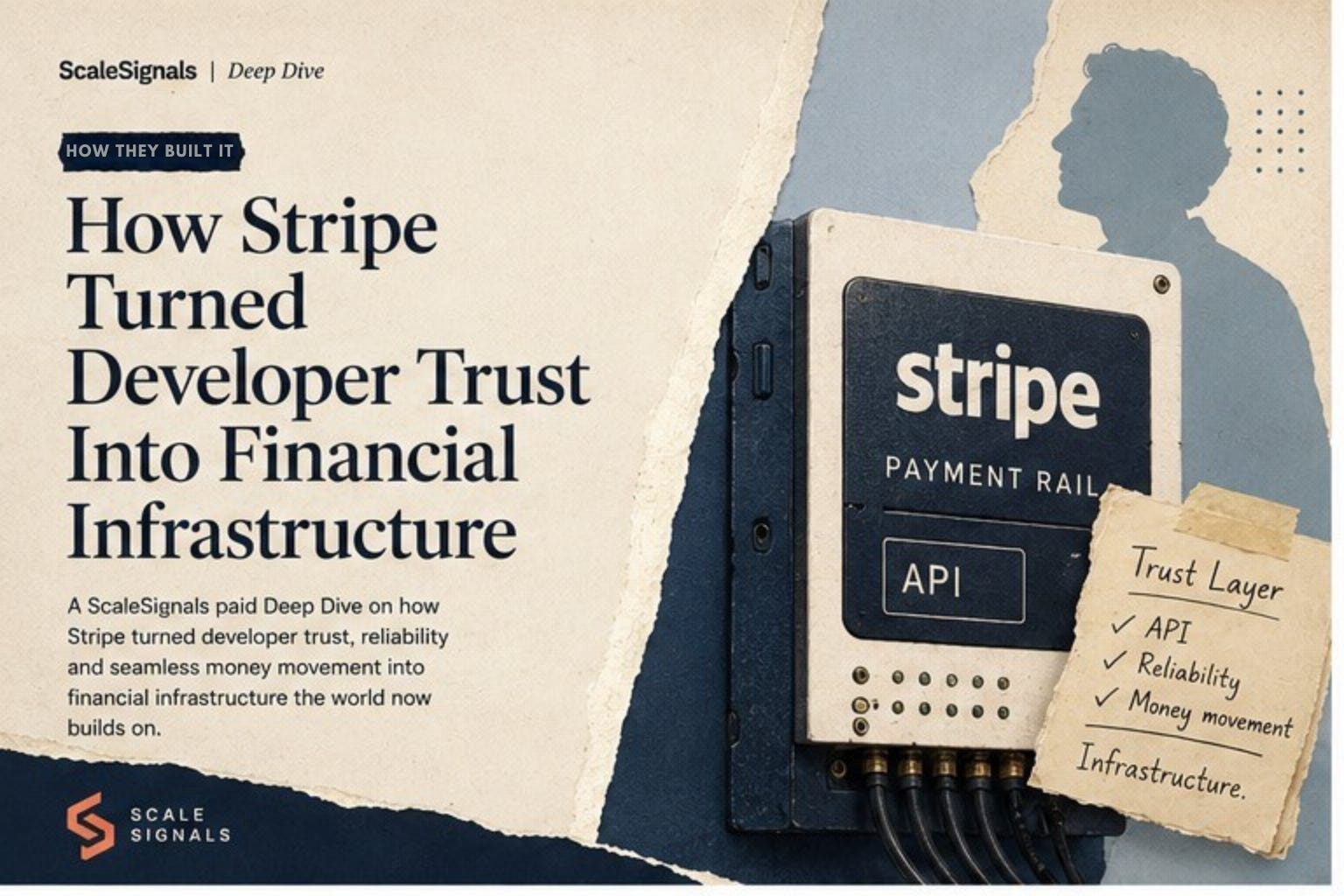
Most people explain Stripe through the things they can easily see: clean APIs, polished documentation, seven lines of code, developer love, a large private valuation, and the Collison brothers’ unusually long-term view of internet commerce. That version is not wrong. It is just too shallow to be useful for anyone trying to understand how a payments company became financial infrastructure.
The more useful question is not whether Stripe made payments easier. It clearly did. The more useful question is how Stripe made developers trust a system that touched money, customers, fraud, refunds, subscriptions, marketplaces, tax, compliance and ultimately the revenue layer of internet businesses. In payments, simplicity is not valuable because it looks elegant. Simplicity is valuable when it reduces fear at the moment something important could break.
Viewed through that lens, Stripe begins to look less like a payments processor and more like a trust expansion company. It started at a narrow point of pain: the developer trying to accept payments without weeks of bank forms, gateway integrations, brittle code and operational uncertainty. But the real advantage was not the first API call. The advantage was that trust earned at implementation could then move outward into more of the business’s financial operating system.
That distinction matters because many founders misunderstand what “developer-first” really means. They treat it as a go-to-market style: better docs, cleaner branding, community goodwill, a more technical buyer, a nicer onboarding flow. Those things can help, but they are not the moat. Developer trust becomes strategically valuable only when the developer is the first person to feel the risk and the company removes that risk in a way the business later depends on.
Stripe’s real advantage was not one API, one checkout flow, one product launch or one founder story. It was a trust expansion loop. A painful implementation problem created the wedge. A developer-first product experience made the system usable. Reliability turned usability into confidence. Confidence gave Stripe permission to expand into adjacent financial workflows. Those workflows made Stripe less like a payments tool and more like infrastructure for internet revenue.
That is the part competitors could see but could not simply copy.
Why this matters
A founder raising capital does not need to copy Stripe. A GP assessing a fintech company does not need another generic essay about payments. An LP judging a manager does not need to hear that developer experience is important. The useful lesson is more precise: durable advantage can appear when trust starts with the person who feels the implementation pain earliest, and then expands into the workflows that make the business run.
Founders lose time when they copy the visible developer aesthetic without understanding the deeper risk Stripe reduced. Investors lose money when they mistake developer enthusiasm for infrastructure durability. Managers lose credibility when they describe a portfolio company as a platform before showing how a narrow product earns the right to expand. Stripe is a valuable case because it shows how an implementation wedge can become an operating layer when trust compounds across product, reliability, workflow and scale.
If you only have three minutes, here is the point. Stripe did not only make payments easier to start. It made payments safer to trust at the moment a developer had to make money move inside a real business. That trust began in the API and the documentation, but it did not stay there. It expanded into checkout, subscriptions, invoicing, fraud, tax, marketplaces, embedded finance, treasury and broader revenue operations.
That does not mean every company should become developer-first. It means the first user who experiences the pain is often not the same person as the buyer, and that user can become the trust wedge for the entire company. In Stripe’s case, the developer was not merely an implementer. The developer was the first risk manager. If the integration was confusing, the business might not get paid. If the API broke, revenue could stop. If the documentation was unclear, launch could slip. If the system could not be trusted, the company would look unreliable to its own customers.
For founders, the useful question is not whether the product is easy to use, but whether it removes the fear that blocks adoption at the point of work. For investors, the useful question is not only whether developers like the product, but whether that developer trust can expand into adjacent workflows with higher strategic value. The public version of the Stripe story is easy to find: seven lines of code, elegant APIs, payments volume, Patrick and John Collison, global internet commerce and a large private valuation. The useful part sits underneath that story, in the operating pattern that turns implementation trust into infrastructure credibility.
For paid subscribers, the rest of this deep dive turns that idea into a working capital lens: the Developer Trust Expansion Loop, the founder questions, the GP/LP diligence test, and the difference between developer love that stays narrow and developer trust that expands into financial infrastructure.
