

How Physical Distribution Still Powers Emerging-Market Fintech
The digital layer gets the valuation. The physical trust layer often does the work.

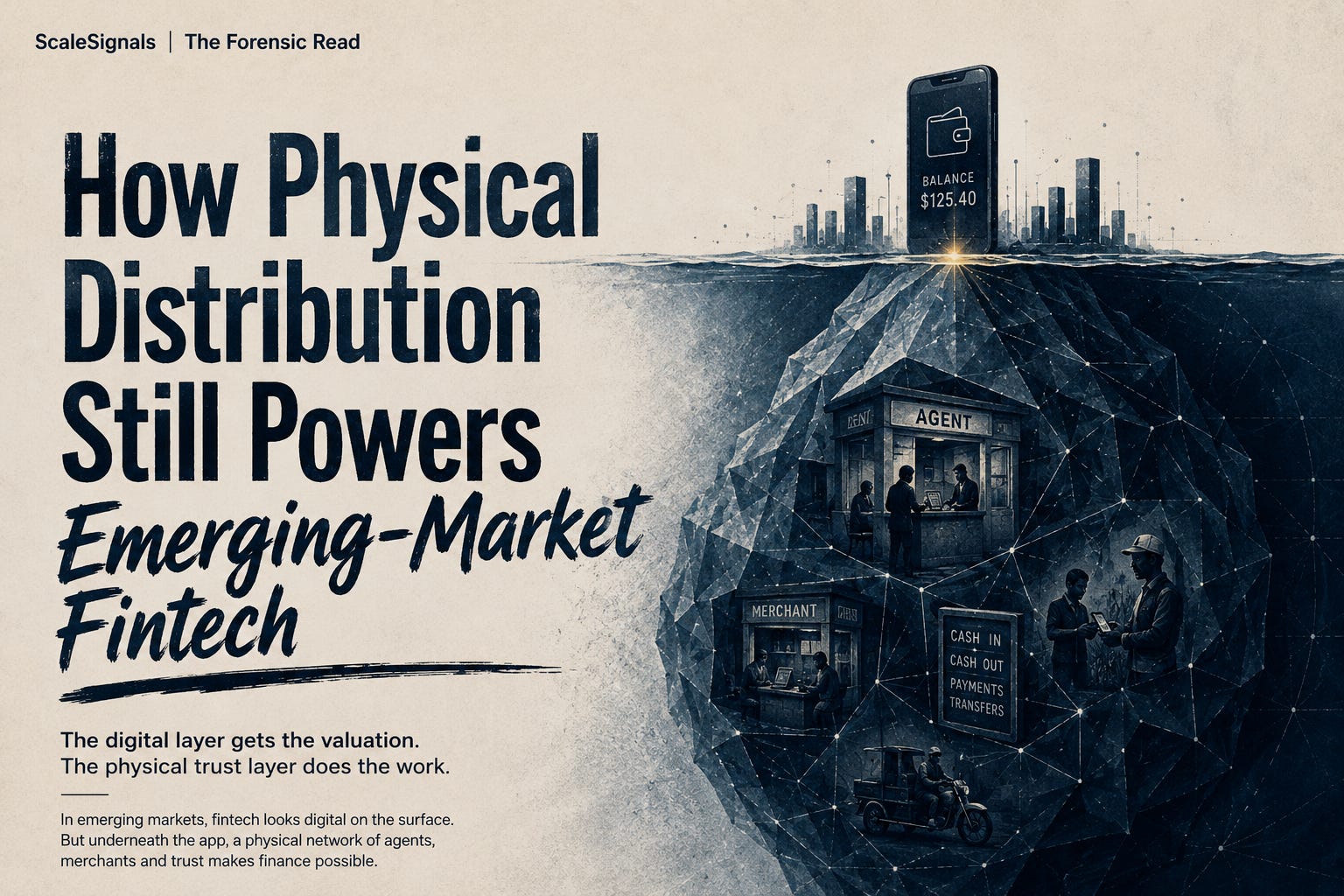
Why Emerging-Market Fintech Runs on Physical Trust, Not Just Software
The market prices these companies as software. The thing that makes them work, and makes them hard to displace, is a physical system that turns trust into transactions. Here is how to read the trust layer, as a founder, GP or LP.
The prevailing belief in finance is that money is becoming pure software. Wallets, rails, stablecoins, banking APIs, neobanks: the story is that the physical apparatus of finance is dissolving into code, and trillions in market value are being allocated on that conviction. The belief is mostly right in the markets that wrote it. It is half wrong in the markets that will add the next billion users.
The half it misses is the one that decides whether any of it works. Somebody, somewhere, has to make a person believe that a number on a screen is really their money, and will still be their money tomorrow. In markets where banks have spent decades earning distrust, that belief is not produced by a better interface. It is produced in the physical world: by an agent who hands over cash, a shopkeeper who vouches for the product, a field officer who fixes the failed transaction. Call it the trust layer. It is the part of an emerging-market fintech that does not appear in the pitch, and it is often the part that makes the company.
The visible company is digital. The deck talks about transaction volume, active users, merchant acquisition, platform expansion. The load-bearing company is frequently physical, and it sits underneath all of that: agents, merchants, cash-in and cash-out points, repayment behaviour, the everyday places where people already move money. Some emerging-market fintechs scale faster than they should on paper because they are not only building software. They are building on top of trust that already exists, or they are building the physical trust layer themselves.
Mobile money is the clean example. The GSMA reports that merchant payments through mobile money grew by almost half in 2025, to $155 billion, the fastest-growing use case in an ecosystem that now moves more than $2 trillion a year. Read from the screen, that is a digital-finance story. But mobile money has always run on an agent and distribution network that lets people convert between cash, balances, merchants and trust. The app did not remove the physical layer; it made the physical layer more valuable.
Which sets up the question the market keeps underwriting too lightly. The transaction is digital. The trust, in these markets, is not. That gap is where the value hides, and where the mispricing happens.
