
How Palantir Built Software Institutions Couldn’t Easily Remove
Palantir’s real advantage was not complexity. It was becoming part of how institutions make decisions.

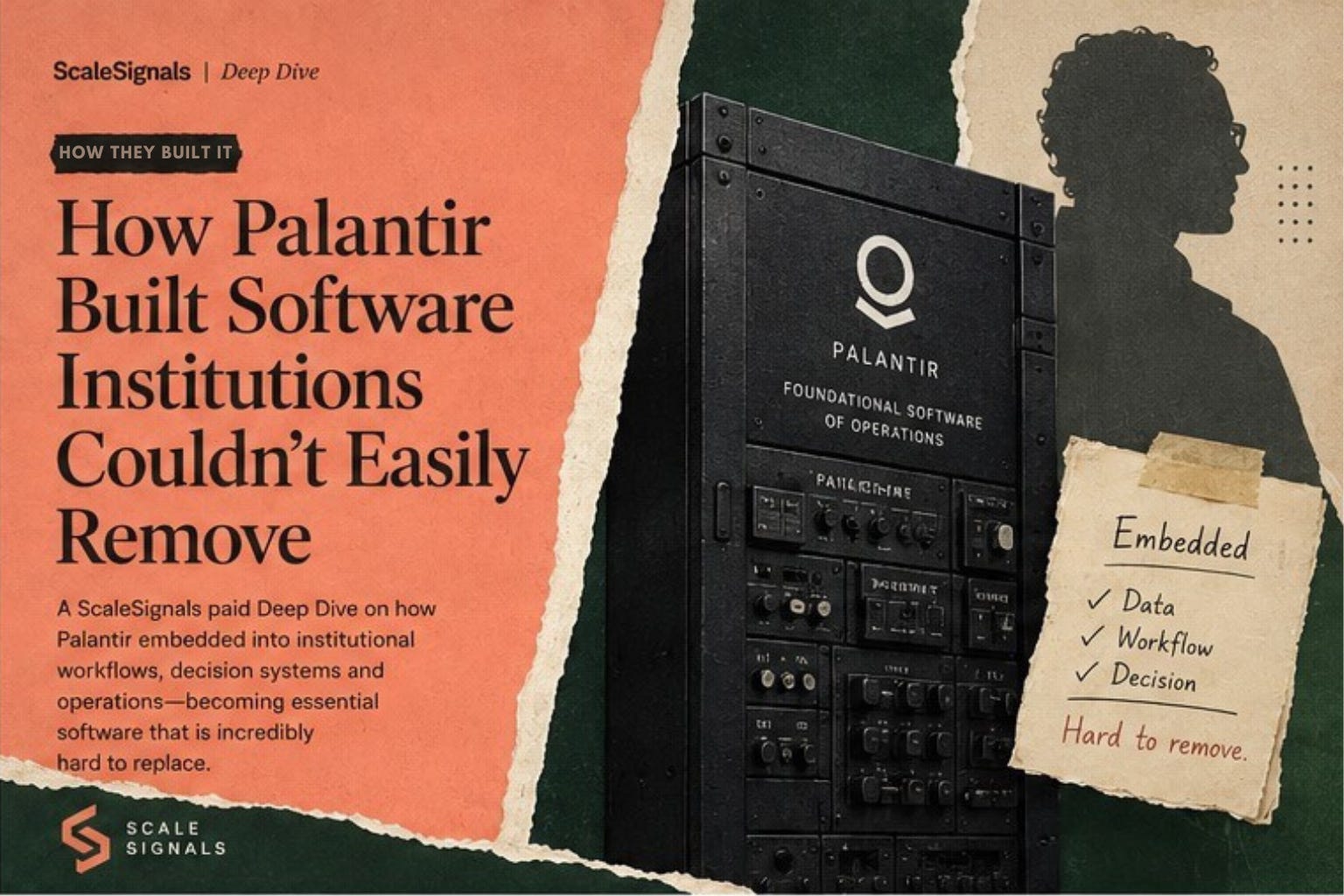
How Palantir Built Software Institutions Couldn’t Easily Remove
Palantir’s real advantage was not complexity. It was becoming part of how institutions make decisions.
Most people explain Palantir through the things they can argue about: government contracts, intelligence work, controversial deployments, Alex Karp, Peter Thiel, defence budgets and, more recently, artificial intelligence. That version is not wrong. It is just too narrow to be useful for anyone trying to understand how software becomes difficult to remove from a serious institution.
The more useful question is not whether Palantir built complex software. It clearly did. The more useful question is how the company built software that could enter environments where data, decisions, permissions, security, workflows and institutional accountability were already tangled together. In those environments, software does not win because it looks elegant in a demo. It wins when it becomes useful inside the mess the customer cannot avoid.
Viewed through that lens, Palantir begins to look less like a conventional software company and more like an institutional embedment company. Its strongest position is not simply that customers use the software, or that the software connects data sources, or that the company has large public and private sector clients. Its strongest position appears when the platform moves closer to the point where information becomes judgment, judgment becomes coordination, and coordination becomes action. The product matters, but the operating position around the product matters more.
That distinction matters because most founders still misunderstand enterprise defensibility. They think stickiness comes from contract length, procurement friction, integration pain or feature depth. Those things can matter, but they are not the same as removal resistance. A product is easier to replace when it is only used for a task. It becomes harder to replace when the customer starts depending on it to understand what is happening, decide what to do next, and coordinate work across teams that do not naturally operate from the same view of reality.
Palantir’s real advantage was not one platform, one contract, one customer segment or one founder. It was institutional embedment. The company entered hard environments, learned from difficult deployments, and built itself into workflows where the cost of removal was not only technical. It was operational. Data became workflow, workflow became decision support, decision support created trust, trust increased switching cost, and switching cost created room for expansion. That is the loop competitors could describe but could not simply copy.
Why this matters
A founder raising capital does not need to copy Palantir. A GP assessing a company does not need to become an expert in government procurement. An LP judging a manager does not need another heroic software story. The useful lesson is more transferable: durable advantage often appears when software moves from being a product the customer buys to being part of how the customer operates.
Founders lose time when they mistake enterprise complexity for enterprise defensibility. Investors lose money when they mistake long sales cycles for deep customer commitment. Managers lose credibility when they describe portfolio companies as mission critical without showing where the product sits inside the customer’s real operating system. Palantir is a valuable case because it shows how difficult customers, deployment knowledge, trust and workflow integration can reinforce each other over time.
If you only have three minutes, here is the point. Palantir did not only build data software. It built an institutional embedment loop. Hard customers created pressure to solve problems that ordinary software could not absorb. Deep workflow integration moved the product closer to the decision layer. Difficult deployments created operating knowledge. Operating knowledge created trust. Trust made replacement harder. Once the product sat near the decision layer, adjacent workflows became easier to reach.
That does not mean Palantir is impossible to remove. No company is. Palantir’s own filings say many customer contracts contain termination-for-convenience provisions, which is a useful reminder that contractual language alone should never be confused with true customer dependency. [S13] The point is not contractual lock-in. The point is that software becomes more defensible when the customer’s practical cost of removal rises because the product has become part of how work is understood, governed and acted upon.
For founders, the useful question is not whether the product sounds enterprise-grade, but where it actually sits in the customer’s operating reality. For investors, the useful question is not only whether the company has large customers, but whether each deployment makes the company more trusted, more embedded, more knowledgeable and harder to replace. The public version of the Palantir story is easy to find: government contracts, data analytics, controversy, AI, Alex Karp and Peter Thiel. The useful part sits underneath that story, in the operating pattern that turns difficult deployments into institutional learning.
For paid subscribers, the rest of this deep dive breaks down that build pattern: how hard customers created harder proof, how workflow integration became more important than adoption, how deployment knowledge compounded quietly, how trust changed the retention equation, and how founders, GPs and LPs can use the same lens to judge whether enterprise software is merely being used or becoming embedded. The lesson is not to copy Palantir. The lesson is to understand how software becomes part of institutional decision-making.
