
Decision Architecture Part 2 — The Diagnostic
How to tell which layer of your company's decision system is currently failing, and which repair matters most

Two weeks ago I made the case that most companies do not have a decision system. They have a meeting calendar and a culture of opinion-having, and somewhere along the way those got mistaken for the same thing. The piece named four layers a working decision architecture needs to have — a question filter, a framing standard, an evidence threshold, and a decision record. The argument was that companies fail when the architecture they had at fifty employees stops working and nobody installs the architecture for two hundred or five hundred.
The response from a handful of founders and operators who read the piece was the same question. Okay. How do I tell which layer is broken in my company.
That is what this piece is for.
The diagnostic is not complicated. It can be done in an afternoon by anyone who knows the company well enough — usually the founder, sometimes the COO, occasionally a board member who has been close enough to the operating cadence to see how decisions actually get made. The discipline is honest, not technical. The questions are simple. The answers are usually uncomfortable.
I have run this diagnostic on roughly forty companies across the last eight years, either as a GP looking at portfolio companies or as an advisor working with founders one layer outside my fund. The pattern is consistent. Almost every company has one layer that is genuinely working, one or two that are partially functional, and at least one that is structurally absent. The repair sequence matters. Fixing the wrong layer first is one of the most common operating mistakes I see.
Diagnosing the question filter
The question filter is the system that distinguishes consequential decisions from operational adjustments before either reaches a decision-maker. When it is working, the company’s senior attention is reliably focused on the questions that change trajectory. When it is broken, every decision feels equally urgent and the company’s leadership team spends its capacity on the wrong things.
The diagnostic for the question filter is to look at the last twenty decisions the company’s senior team has actually spent meaningful time on. Not formal decisions in board meetings. The decisions that have absorbed real attention — the ones that have generated Slack threads, occupied executive lunches, become the topic of the founder’s weekend thinking. Write the twenty down honestly.
Now categorise each one. Some will be genuinely consequential — decisions whose outcome materially changes the company’s trajectory. Some will be operational adjustments that felt strategic because the person raising them was senior, or because the company had no system to filter them. Some will be reactive — decisions made in response to outside pressure that probably should not have required senior attention at all.
A healthy question filter produces a list where roughly seventy percent of the twenty decisions are genuinely consequential. A broken question filter produces a list where less than thirty percent are. Most companies sit somewhere in the middle, with maybe forty to fifty percent of senior attention being spent on questions that probably did not warrant it.
The reason this matters is that decision capacity is finite. Every consequential decision that the senior team makes well requires preparation, framing, evidence, and time. If half of the team’s capacity is being consumed by questions that should have been handled at a lower level, the genuinely consequential decisions are being made by leaders who are already depleted. The cost is invisible in any single decision and visible across the cumulative pattern of how the company performs.
The repair for a broken question filter is to install an explicit triage standard. Before any question reaches the senior team’s attention, it gets categorised — operational, requires senior input, or genuinely consequential. Operational questions are handled by whoever owns the relevant function without escalation. Senior-input questions get a single conversation, not a process. Genuinely consequential questions enter the full decision architecture. The triage is done by someone — chief of staff, COO, occasionally the founder themselves — but it is done explicitly, not implicitly, and the categorisation is written down. Most companies that install a question filter find that the proportion of senior attention spent on consequential questions doubles within three months.
Diagnosing the framing standard
The framing standard is the discipline that forces every consequential question into the framing that surfaces the largest hidden cost or opportunity, not the framing that the original asker happened to use. When it is working, the company makes decisions on the most important version of the question. When it is broken, the company answers the question it was asked rather than the question that mattered.
The diagnostic for the framing standard is to take the five most consequential decisions the company has made in the last twelve months. For each one, write down two things. How was the question originally framed when it first reached the senior team. And was that the framing that was ultimately used to make the decision.
A healthy framing standard will show a clear pattern — the question that arrived was usually reframed at least once, sometimes substantially, before the decision was made. Someone in the room said I think we are asking the wrong question and the framing shifted. A broken framing standard will show the opposite pattern — the question that arrived was the question that was answered, and the framing was inherited from whoever raised it first.
The reason this matters is that the framing of a consequential question determines what answer is even possible. A pricing question framed as should we raise prices produces a different decision to the same question framed as what are we currently leaving on the table. A market-entry question framed as should we enter Brazil produces a different decision to what is the highest-return geography we could enter with the team we have today. Neither reframing is more correct in the abstract. But one of them will be more useful to the specific company at the specific moment, and the company without a framing standard tends to default to the framing that came in the door, which is rarely the most useful one.
The repair for a broken framing standard is to install a single discipline at the start of every senior decision conversation. Before the discussion of the substance begins, somebody asks one question. Is this the most useful framing of what we are actually deciding. Sometimes the answer is yes and the conversation proceeds. Sometimes the answer is no and ten minutes are spent reframing the question before any substantive discussion. The ten minutes are the most leveraged time the senior team will spend on the decision. Most companies that install this discipline find that the quality of their consequential decisions improves visibly within six months, not because the decisions themselves are smarter but because they are about the right questions.
Diagnosing the evidence threshold
The evidence threshold is the standard that calibrates how much rigour each decision class deserves. When it is working, reversible decisions with low cost get made quickly and non-reversible decisions with high cost get the structured evidence they require. When it is broken, the company either over-deliberates the small stuff to the point of paralysis, or under-deliberates the large stuff because the meeting culture treats every decision as roughly equivalent.
The diagnostic for the evidence threshold is to take the five most consequential decisions from the previous exercise — the same five used to diagnose the framing standard — and ask one question of each. Was the decision made with structured evidence proportionate to its consequences, or was it made on instinct, on a single advocate’s argument, or on incomplete data.
The honest answer for most companies, on most consequential decisions, is the second one. Not because the company is reckless, but because the evidence threshold has not been explicitly set and the default cultural standard tends to favour conviction over rigour, especially when the company is run by a strong-conviction founder. The decision feels well-made because it was made decisively. Whether it was made with adequate evidence is a separate question, and one that most companies do not ask in real time.
The diagnostic gets sharper when you cross-reference with outcomes. Take the consequential decisions made twenty-four months ago and ask which ones, in hindsight, the company would make again with the benefit of what is now known. If the answer is most of them, the evidence threshold is probably functional. If the answer is fewer than half, the evidence threshold is not strict enough — too many decisions were made on instinct or on insufficient data and have not aged well.
The reason this matters is that the cost of a wrong consequential decision is almost always asymmetric. A pricing change that goes wrong can be reversed in a quarter. A market-entry decision that goes wrong cannot be unwound for years. A hiring decision at the executive level that goes wrong consumes eighteen months of company time and a meaningful fraction of the founder’s emotional capacity. The evidence threshold is what calibrates the rigour against the asymmetry. Without it, the company spends the same level of effort evaluating decisions whose consequences differ by orders of magnitude.
The repair for a broken evidence threshold is to install a simple classification before any consequential decision conversation begins. Is this decision reversible or non-reversible. What is the cost of being wrong. Given those two answers, what level of evidence is required for the senior team to make this call confidently. The classification takes five minutes. It transforms the discipline of the conversation that follows. Reversible low-cost decisions get made quickly on instinct, with the understanding that the team will revisit if early signal is bad. Non-reversible high-cost decisions get the structured evidence they need, and the conversation does not move forward without it.
Diagnosing the decision record
The decision record is the substrate that converts experience into institutional intelligence. When it is working, the company can reconstruct what it actually believed at the time of any past consequential decision, which means it can learn from the mistakes and reinforce the successes. When it is broken, decisions disappear into the past undocumented, and the company’s institutional memory becomes a function of who is in the room remembering what.
The diagnostic for the decision record is the simplest of the four. Pick any consequential decision the company made eighteen to twenty-four months ago. Ask the senior team — separately, without consulting one another — to write down what was decided, what evidence supported it, what the dissenting view was, and what would have caused the decision to be revisited.
The answers will differ. They will differ more than you expect. Sometimes substantially. The team will remember different versions of the same decision. The dissenting view will be remembered by some members and forgotten by others. The triggering conditions that would have caused a revisit will, in most cases, not be remembered at all.
This is not a failure of the team’s memory. It is a failure of the decision record. Memory is unreliable. Without a written record, the company’s understanding of its own past decisions is a function of whose memory is loudest in the current moment, and that produces predictable distortions. Successful decisions get over-remembered as inevitable. Failed decisions get rewritten so the dissenting view becomes the dominant one in retrospect. Neither version is true, and neither produces useful learning.
The reason this matters is that the value of a decision system is mostly in the learning loop, not in the individual decisions. A company that makes a hundred consequential decisions across five years with no decision record cannot meaningfully learn from any of them. The same mistakes get made again, attributed to different causes. The same patterns recur, treated as new problems. The institutional intelligence does not compound, which is the entire point of building a system in the first place.
The repair for a broken decision record is the lowest-effort, highest-leverage intervention of the four. After every consequential decision, one person — chief of staff is usually the right role — writes down four things. What was decided. What evidence supported it. What the dissenting view was. What would cause this decision to be revisited. The artefact is one page. It takes thirty minutes to produce. It lives in a single accessible location, not buried in meeting notes or board minutes. The discipline is to produce it for every consequential decision without exception, even — especially — the ones that feel obvious at the time. Most of the value comes from the discipline, not from any individual record. After two years of consistent recording, the company has an institutional memory that compounds in a way no other intervention produces.
The repair sequence
The four layers do not need to be fixed in parallel. There is a sequence that matters, and the wrong sequence is one of the most common operating mistakes I see.
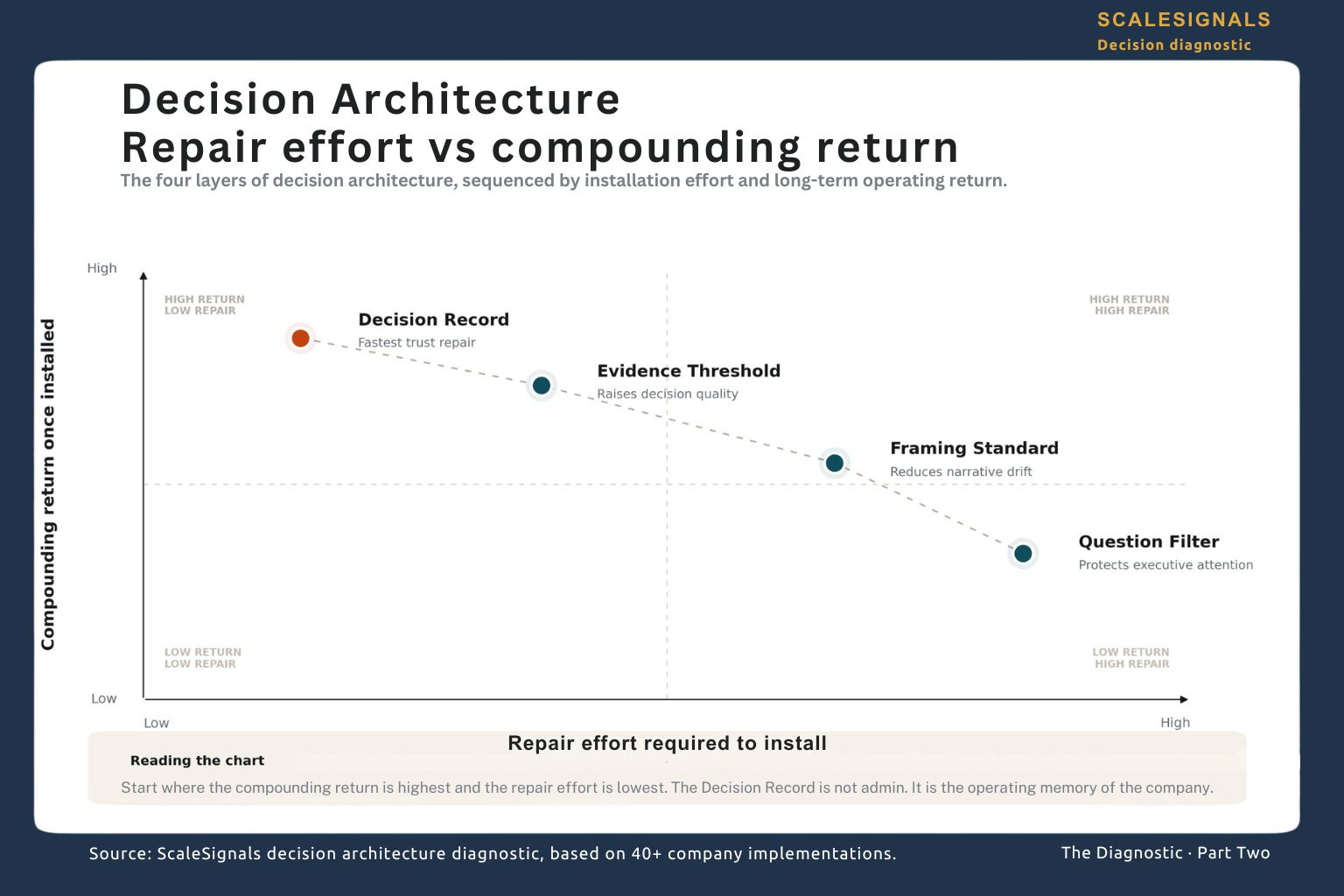
The sequence is — decision record first, evidence threshold second, framing standard third, question filter fourth.
This is counterintuitive to most founders, who instinctively want to fix the question filter first because it feels like the front of the funnel. The reasoning behind the actual sequence is that each layer’s repair depends on the layer below it being functional.
You cannot install a useful evidence threshold without a decision record, because you have no way of knowing in hindsight whether the threshold you set was right. You cannot install a useful framing standard without an evidence threshold, because reframing a question only matters if the company is going to do the rigour to evaluate the reframed version honestly. You cannot install a useful question filter without a framing standard, because the filter has to be able to distinguish questions that need framing from questions that need only operational adjustment.
The bottom layer — the decision record — is the foundation. Install it first. It is the lowest-effort change and the highest-compounding return. Most companies that install nothing else still benefit substantially from running a six-month discipline of writing down what was decided and why.
The second layer — the evidence threshold — installs once the record is producing data. After two or three quarters of consistent decision records, the company can look at its own pattern and calibrate the threshold honestly. Decisions that got insufficient rigour are visible in retrospect. The threshold gets tightened where it needs to be.
The third layer — the framing standard — installs once the evidence threshold is functional. The reframing exercise only produces value when the company has the discipline to evaluate the reframed question with the rigour it deserves.
The fourth layer — the question filter — installs last. By the time you reach it, the company has the architecture to handle consequential questions well, which means the filter has a meaningful job to do. Installing the filter first, before the lower layers are functional, produces a triage system that escalates questions into a decision system that cannot handle them anyway.
The full architecture takes most companies eighteen to twenty-four months to install properly, working through the layers in sequence. This is longer than founders expect. It is also the right pace. The institutional muscle being built — the discipline of running consequential decisions through a system rather than through the founder’s intuition — has to be developed by use. It cannot be shortcut.
The directive
For founders, GPs, and board members reading this in advance of next week — the four diagnostics in this piece can be run in an afternoon. The honest answers, written down, produce a clear picture of which of the four layers is the highest-leverage repair right now.
If the diagnostic surfaces that the decision record is the layer to start with — which it will for most companies that have never explicitly built one — the work to begin is the simplest piece of operating discipline available to a growth-stage company, and it produces compounding returns from the first month it is in place.
Part 3 of this series, in two weeks, takes on the harder version of the problem. What to do when you have inherited a company that has been operating without a decision architecture for years, where retrofitting one feels impossible. It is not impossible. But it requires a different approach to the one you would use if you were building from scratch, and almost no operator literature addresses it. That piece is for the boards and incoming executives currently looking at companies in that exact position.
For now — the diagnostic. An afternoon. Honest answers. One layer to start with. The rest can wait.
Ben Botes is an active GP, 4x exited founder, and MD of Caban Group. He has spent 24 years across venture, private equity, governance, and scale-ups, and is the author of the Amazon bestseller Unstoppable Growth*. Through ScaleSignals, he helps founders and fund managers stop wasting their raise on the wrong investors by building stronger evidence, clearer investor fit, and better capital conversations.*
In two weeks — Decision Architecture Part 3: Inheriting a company with no architecture. The hardest version of the problem, and the one most boards will eventually face.
ScaleSignals paid tiers launch end of June. Membership £99/year for founders and emerging managers building practical operating intelligence. Pro £400/year for the full Decision Architecture toolkit, diagnostic templates, and board upgrade frameworks. Institutional from £5,000/year for GPs, LPs, and teams needing the full intelligence layer.